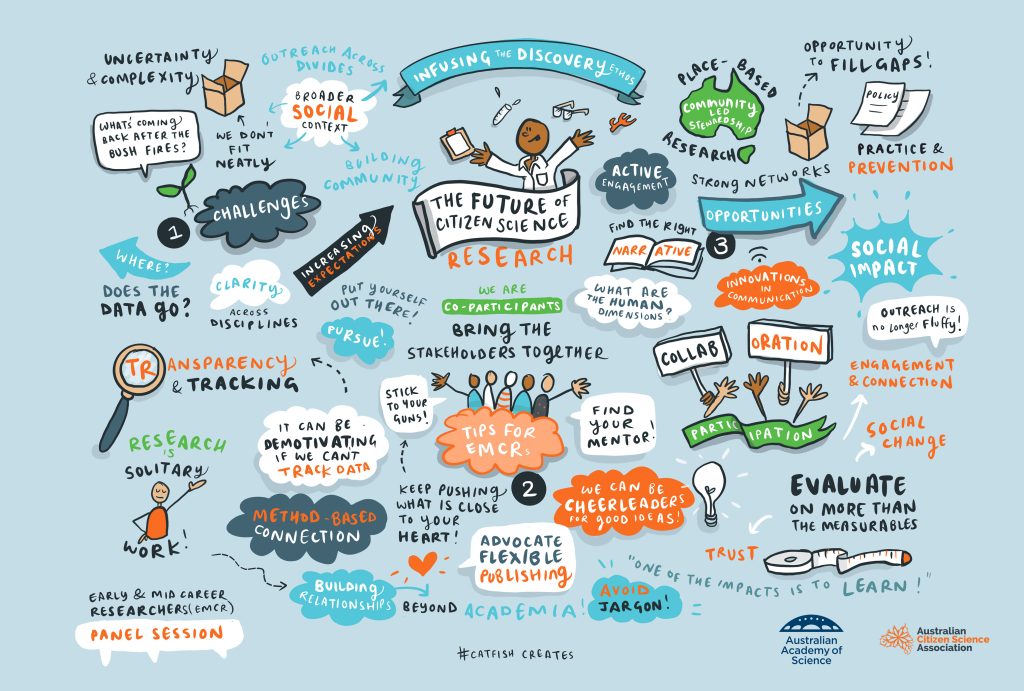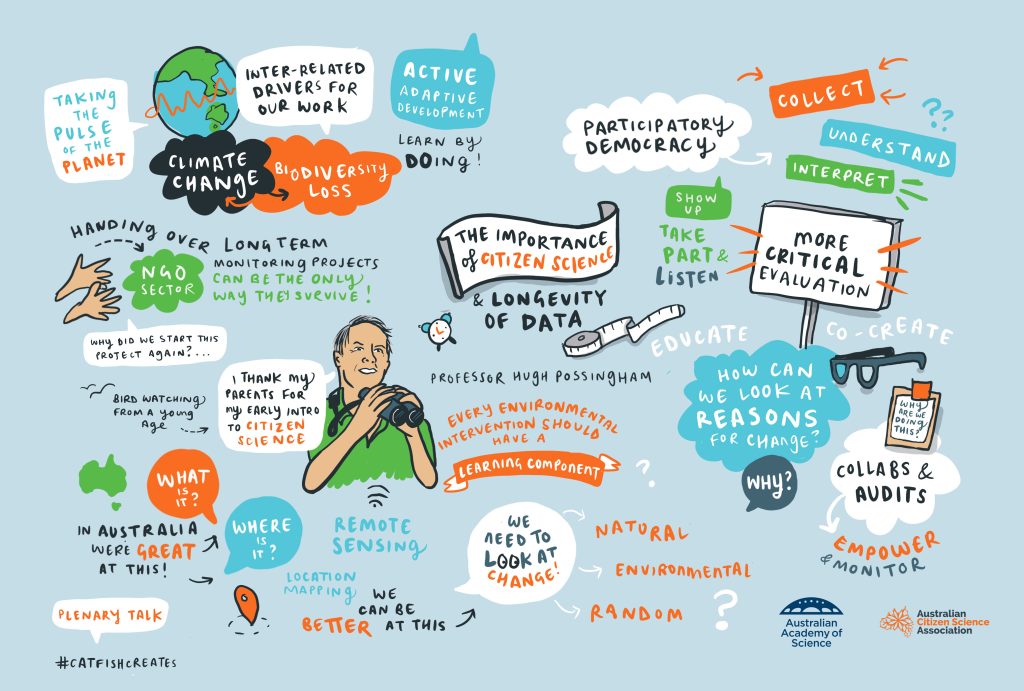
Early and Mid-Career Researchers (EMCRs) represent the future of Australian research, and can both benefit from and contribute to the growing citizen science sector. Growing genuine collaborations and partnerships across citizen science and EMCR work can empower research to enhance the positive impacts of citizen science for science and society.
Are you interested in joining an EMCR community of practice?
How can a community of practice help you in your work? What should we focus on?
ACSA Theo Murphy Initiative Funding 2022-2024

Citizen science Grants
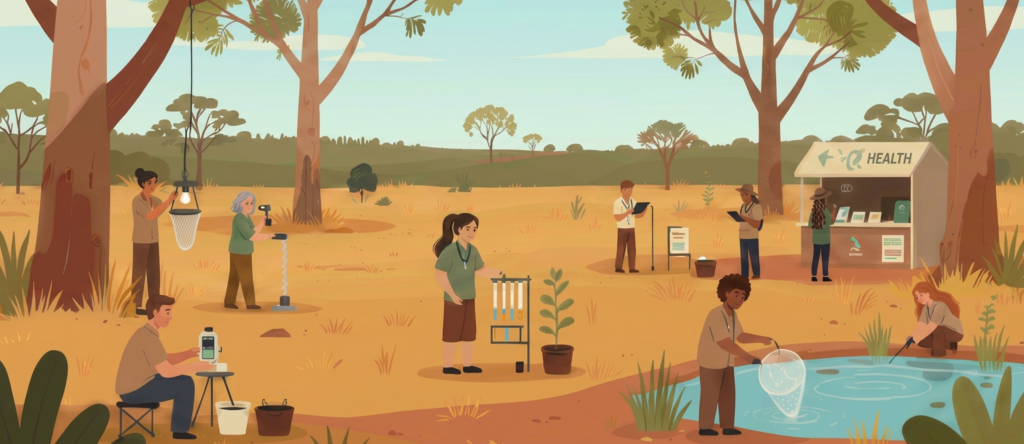
ACSA was successful in securing support from the Australian Academy of Science’s Theo Murphy Initiative for a round of grants specifically for EMCR-led research with and for citizen science. Three projects were funded to enable EMCR-led research that enhances the positive impacts of citizen science for science and society. Below is a brief summary of the projects.
Mapping and quantifying home and community food production through citizen science (Project lead Ro McFarlane)
This project was codesigned with backyard food producers in 2022, then engaged 120 participants to contribute data collection to quantify and map backyard food production in Canberra. Over 50 types of fruit and vegetables were reported with tomatoes, zucchinis, herbs and beans the most frequently reported. Respondents were producing above the weekly intake of 5 serves vegetables/day/pp. The project continues to explore opportunities with other initiatives to support simple, robust data collection around backyard food production and recognition of the importance of local food systems.
- Final stakeholder report here 2024 – https://www.canberra.edu.au/about-uc/faculties/health/future-of-food/assets/FFCBR-Stakeholder-report-October-2024.pdf
- Future of Food website – https://www.canberra.edu.au/about-uc/faculties/health/future-of-food/future-of-food-survey
Eat, Sleep, Exercise, Repeat: Engaging Young Shiftworkers as Citizen Scientists to Co-Design Health Resources (Project leads Dr. Charlotte Gupta, Dr Grace Vincent, and Alex Shriane at Central Queensland University )
This project engaged with 29 young shiftworkers to gather lived experience information to inform a suite of evidence-based resources for young Australian shiftworkers to improve health behaviours. For the young shiftworkers involved, this project was an opportunity to understand citizen science and the value in participating in research that directly impacts them. The resources and a peer-reviewed publication will promote the role of shiftworkers as citizen scientists among the research community. The project team hopes that this example can increase the presence of citizen science in new research areas.
- Published paper 2025 – “Co-designed resources to improve sleep health in young shiftworkers: a qualitative study” https://doi.org/10.1016/j.sleep.2025.106511
Monitoring tree health to build more resilient Australian urban forests (Dr. Manuel Esperon-Rodriguez)
This project scoped the potential for an Australian Urban Tree app, leveraging citizen science to contribute real-time data on urban tree health observations. The team met with 15 local councils and citizen groups across five cities in QLD, NSW and WA and collected valuable information on methods of data collection to monitor tree health and failures, caveats, and additional uses of the app. One of the key findings of this project was confirmation that local councils appreciate the value of citizen science as a monitoring tool to provide early detection and help find new solutions for monitoring and caring for urban forests. The team is using this information to inform development of the app.
- Published paper 2025 – “A nation-wide urban trial network of tree and shrub climate resilience” https://doi.org/10.1016/j.ufug.2025.128720
Discussion Paper on citizen science
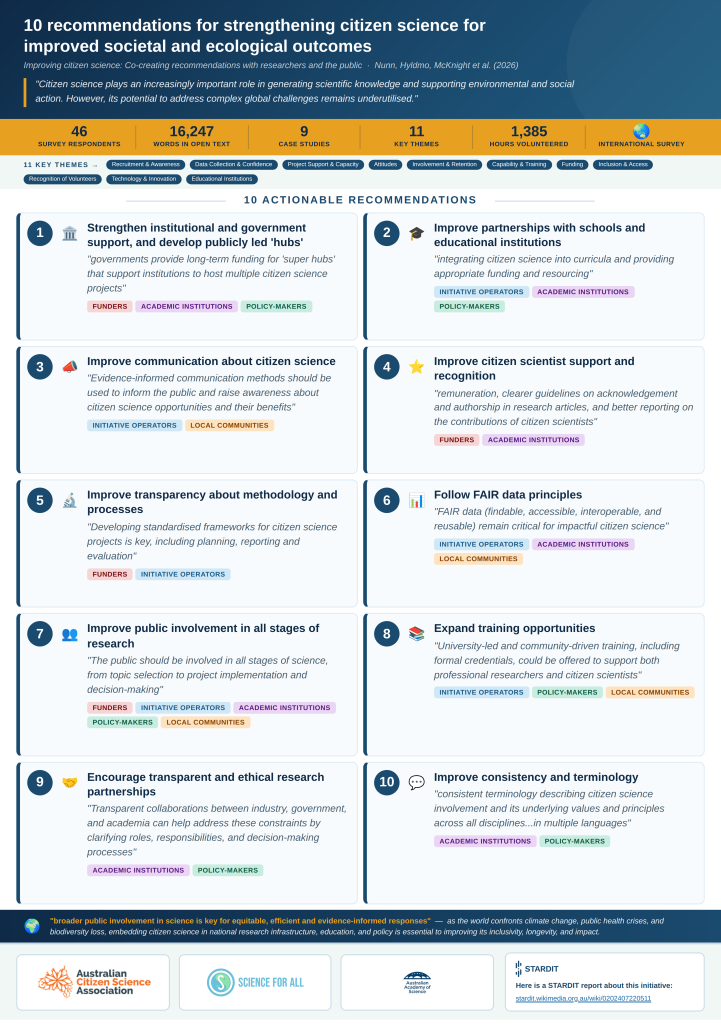
In addition to supporting EMCR project grants, the EMCR project partnership with the Theo Murphy Initiative supported the development of a discussion paper focused on – How can citizen science initiatives in Australia be strengthened to maximize their benefits for society, while addressing the challenges faced by both citizen scientists and research institutions? The project was coordinated by Jack Nunn from Science for All and used a mixed-methods approach combining both qualitative and quantitative methods. It included a review of publicly accessible information and survey data of citizen scientists and researchers involved in citizen science projects to better understand experiences, perceptions, and needs.
- Published paper July 2026 – Nunn JS, da Silva Hyldmo H, McKnight L, McCulloch H, Lavers J, Old J, et al. (2026) 10 recommendations for strengthening citizen science for improved societal and ecological outcomes: A co-produced analysis of challenges and opportunities in the 21st century. PLoS One 21(7): e0331161. https://doi.org/10.1371/journal.pone.0331161
- See here ACSA news release on the published article – https://citizenscience.org.au/2026/07/02/paper-10-recommendations-for-citizen-science-into-the-future/
EMCR Seminar Series – 2021
With a goal to unite citizen science aligned researchers and practitioners in Australia, a seminar series supported through the Theo Murphy Initiative was a space to advance scholarship, provide support, share resources and advocate for new opportunities. We heard from researchers conducting citizen science research in Australia, discussing challenges and opportunities we face while conducting such research and offer support for researchers taking their first steps into citizen science.
See the ACSA Youtube chanel for the Lunchtime EMCR series – https://youtube.com/playlist?list=PLnEVx-lwUz1B6O3A3QXw9debCBxBd2bj7&si=8hgWbjxEhIBZli3z
CitSciOz21 – national conference – EMCR Session
A EMCR working group helped to deliver two EMCR focused events as part of CitSciOz 2021 including:
- A panel discussion: The future of citizen science research – a scholarly conversation with early, mid and senior career citizen science researchers”, which reflected on the challenges faced by citizen science researchers, discuss opportunities, and attain wisdom from those more experienced in academic life.
- A plenary session as part of the EMCR sessions was presented with Professor Hugh Possingham, Queensland Chief Scientist to explore citizen science, research and conservation connection